How is my love for acting related to Castile soap?
When I play a character in a show, I not only get to fill their shoes, I also trace their footsteps.
Here I am with my fellow actor Dah in our production of I Hate Hamlet. I absolutely loved my costumes for this show…I felt like a princess!
Because of this, I’ve travelled through a number of character paths that have taken me around the world: I’ve stolen a Commedia dell’arte romp through the winding canals of Venice, floated through the dreamscape of Charles Dickens’s London, explored the historical and haunted flats that make up the New York City skyline, and washed a peasant’s laundry in (and I think you’ll see where I’m going here) Castile, Spain.
Castile? Wait, isn’t that a type of soap?
You guessed it!
The history of soap
Early soaps were made from combining animal fats and plant oils with salt or ash. This primitive soap was used for cleaning cooking utensils and medicinal purposes rather than for beauty and personal hygiene. As soap making became more refined it also became more expensive because it required both technique and coveted family recipes. Prices only dropped after production became more mainstream when chemicals were introduced to simplify the process.
What is Castile Soap?
Castile soap has been around for quite some time, but unlike the first soaps ever made it does not contain animal fat or ashes. However, a traditional Castile soap is also free from modern chemicals used in most mass-produced soaps.
So if it doesn’t have chemicals or animal byproduct, what exactly is it made of?
Olive oil.
And I’m sure you already guessed where those olives were grown.
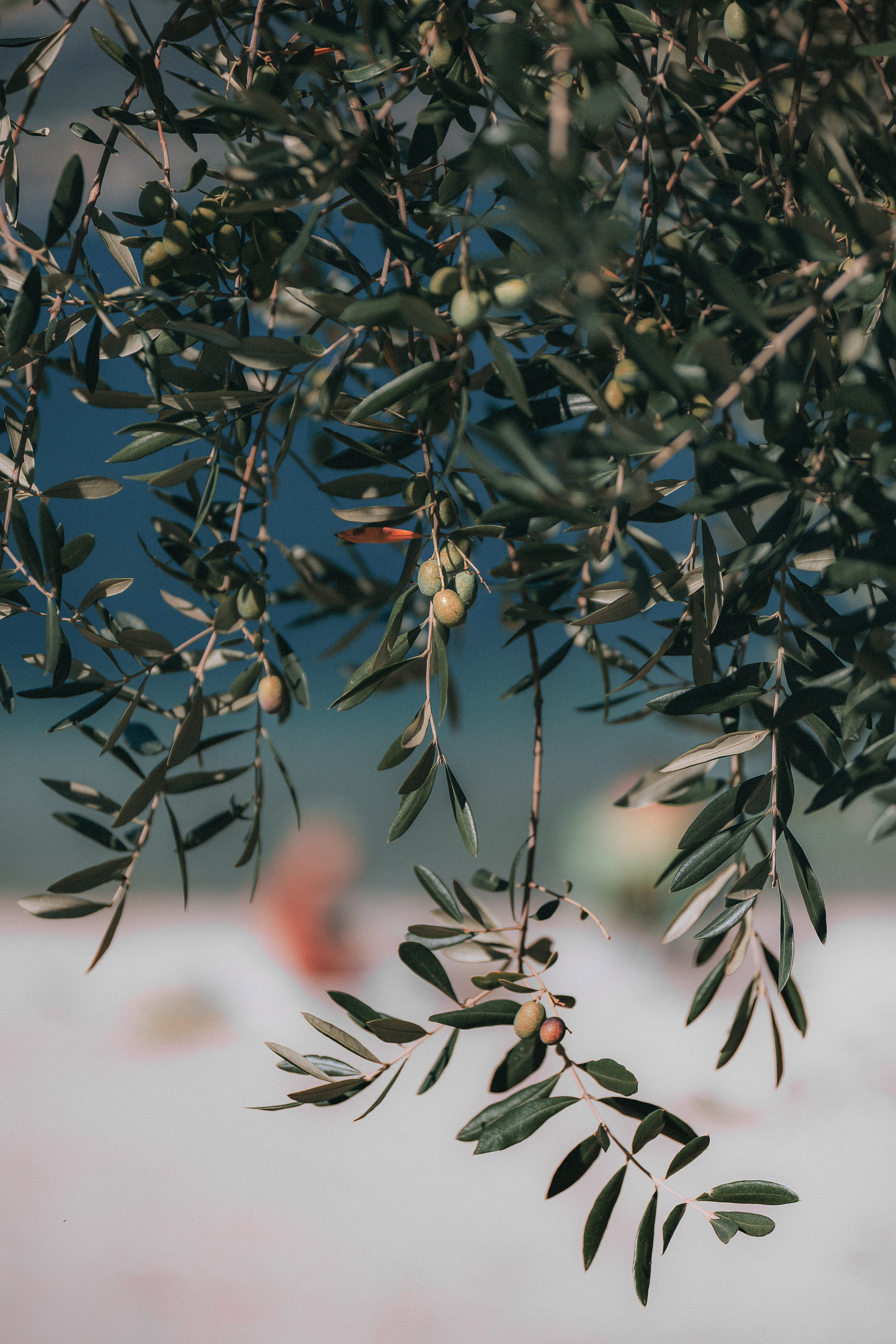
Spain exports the world’s majority of olive oil and the production of olive oil in Spain can be traced back about 3,000 years. Although Castile soap got its name from a specific region in Spain, Castile soap can be made with olive oil from anywhere…which has its disadvantages.
The benefits of olive oil in Castile soap
Because Castile soap is generally defined as soap made with olive oil, many companies can get away with using small quantities of low grade olive oil while still labeling the soap as “Castile Soap” This soap will not have the same benefits as a soap composed of high quality olive oil.
Now, the advantage of using olive oil from outside of Castile is that it allows us to pick from the best. In keeping with the origins of the first Castile soaps, our organic virgin olive oil is sourced mainly from the Mediterranean region. Our true Castile soaps provide a gentle cleanse and act as a nourishing moisturizer. Our virgin olive oil is chemical free and retains its vitamin content, the reason behind olive oil’s health benefits (especially vitamin E). Vitamin E protects skin from the damage of free radicals and can help alleviate symptoms of eczema.
We choose to go organic with our virgin olive oil and many of our other products to promote the protection of the earth and water from harmful pesticides and we want our Castile soap to do the same for your skin. Our Calendula Castile Bar is the perfect soothing solution for sensitive skin (babies would highly recommend it…if they could talk). Our Lavender Castile Bar will create a calming, creamy lather…perfect for shaving! I know I’ve got the Lavender Orange Castile Bar on my wish-list and I’ve got an audition for Antigone tomorrow so I’m ready to get into character (Greece likes its olive oil too!)
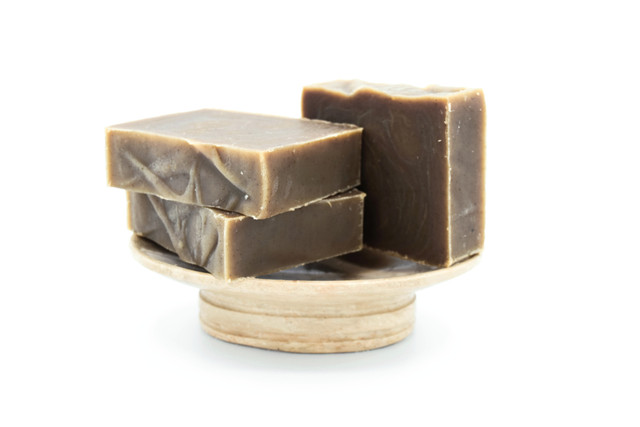
If at first glance you mistook the photo above for a thick block of delicious chocolate fudge, don’t worry, I did too. Believe it or not, that’s actually the Salted Chocolate Sink Bar…so even if you can’t sink your teeth into it, you can still give your hands a good lather. The Salted Chocolate isn’t the only AVNS soap bar that looks good enough to eat, in fact, just browsing the AVNS website makes me feel like a kid in a candy store, and let me tell you, meeting Marianne for the first time felt a little like shaking hands with Willy Wonka himself.
I love chocolate, so it’s no surprise that I adore Rohld Dahl’s classic tale, Charlie and the Chocolate Factory. I’ve always envied Charlie Bucket, the young hero who visits the mysterious and alluring chocolate factory and is swept into a whimsical adventure as he becomes privy to the secrets and inner workings of the fantastic factory.
While Charlie’s journey allows readers to peer into the fantastic world of Wonka’s factory, today I’ll be giving you the inside scoop on the process behind making our scrumptious soap!
Soap needs to be clean in order to clean!
You can have a giant factory with a bazillion hallways and rooms and a giant chocolate-churning fountain…or just a simple kitchen, but no matter where you set up, both Wonka and Marianne will agree that an important step in the creative process is cleanliness. When Augustus Gloop falls into Wonka’s chocolate river, Wonka is more distraught by the thought of contamination than he is about Gloop’s safety. The spaces where AVNS soap is made undergo scrutinous sterilization to ensure that the purity of each product remains intact.
Combining and balancing ingredients
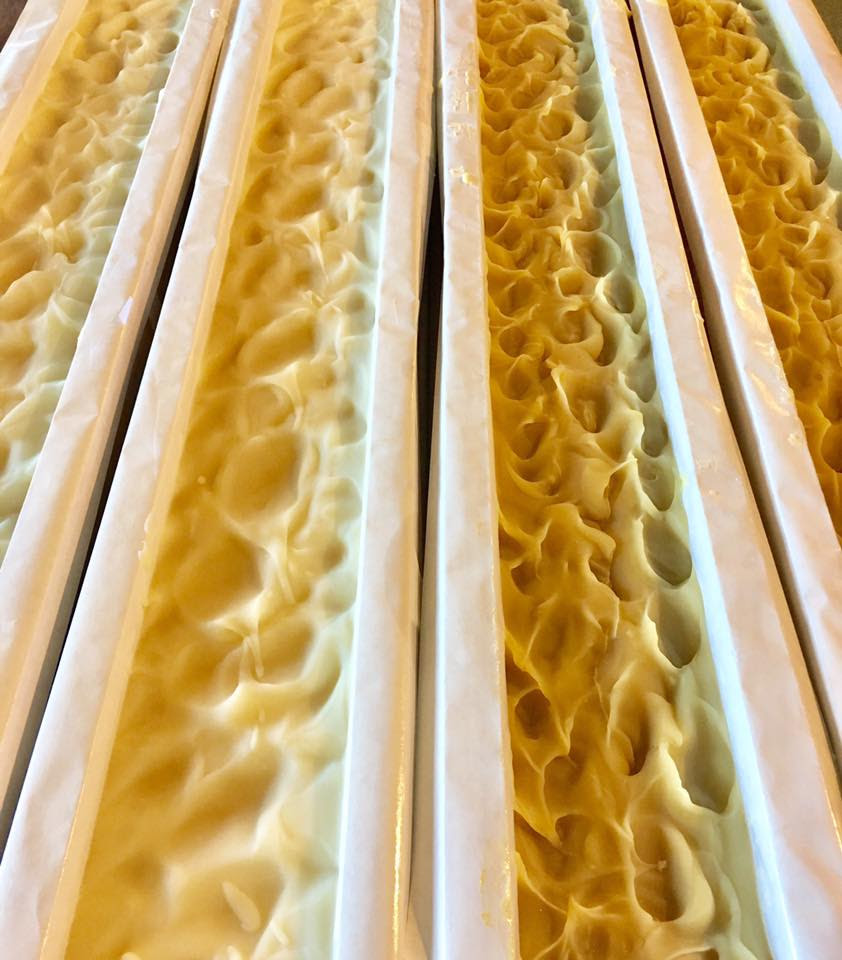
The next step in soap making is to create a recipe. Great soap calls for a great recipe. The base ingredients lye and water are combined. The oils and butters are also combined as they gently melt at the correct temperature. Any delicate, heat-sensitive oils are added secondarily. When both the lye and oils are at the correct temperature, they are blended together until light trace (soap talk for the absence of oil streaks in the mixture). Finally, any essential oils and herbs are added and the soap is poured into molds.
As any chocolatier or “soaplatier” will tell you, attaining the correct balance of ingredients is essential. After Augustus Gloop gets sucked up the chocolate pipe and carried away to the fudge room, Mrs. Gloop panics at the thought of her son being turned into fudge. However, Mr. Wonka (knowing that Gloop would unbalance his recipe) reassures her he will not allow this to happen, “’Because the taste would be terrible..Just imagine it! Augustus-flavoured chocolate-coated Gloop! No one would buy it” (Dahl).
Can you imagine? Salted Chocolate Gloop Sink Bar? No, thank you.
The setting and curing process
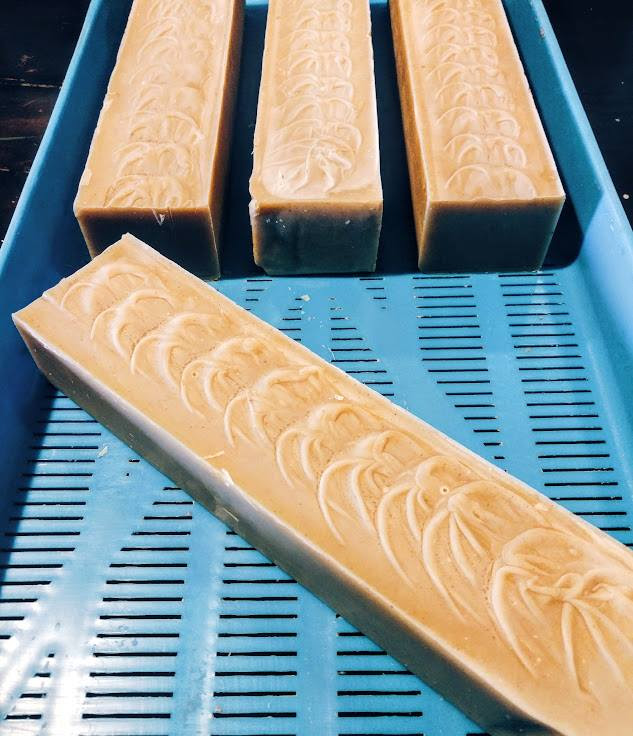
One of my favorite parts in Charlie and the Chocolate Factory is when Violet Beauregarde steals a stick of gum from Wonka’s Great Gum Machine and starts chewing. Wonka tries to warn the greedy girl that his recipe is premature, but Violet does not heed his warning and before she knows it, she begins to swell like a blueberry while consequently turning a violent shade of violet. Using our soap will never turn you into a blueberry because like Willy Wonka, we know that timing is everything. After the soap is poured into molds it sets for 12-36 hours and then cures for another 2-6 months.
What matters most
Willy Wonka prides himself on the inventive and exotic origins of his candy creations, but what is most important to him — and what Charlie learns during his visit — is that at the end of the day, what really matters most is the chocolate.
AVNS has an impressive selection of unique soaps, all different and all hand made…but when stripped down to the core, there is a greater mission at hand. All of AVNS soaps are biodegradable, meaning that every ingredient used in an AVNS bar of soap can be broken down by microorganisms. This natural form of decomposition is eco-friendly, making our soaps like the Organic Coconut Bars, Organic Castile Soap Bars and the seasonal Camping Bar great (and packable) for your camping expeditions!
Although the Salted Chocolate Sink Bar is inedible, it does have a little Wonka-esque trick up its sleeve: it doesn’t contain added scent. The minimal ingredient list allows the natural scent of delicious organic cocoa butter to smell for itself! This isn’t the only unscented soap bar, many of our natural and organic soaps use minimal ingredients to cater to both the environment and sensitive skin. Our Calendula Castile Bar is only composed of saponified organic extra virgin olive oil and organic calendula petals, that’s a peace-sign amount of ingredients!
By using minimal, natural ingredients to make our soap, AVNS aims to promote peace: both inner and with the earth. I’d pick that kind of peace over a piece of chocolate any day.
P.S. Although our soap looks good enough to eat (and is Gloop-free) please do not nibble!
Buying toothpaste is probably one of the most mundane errands in existence. You can stand in the dairy section of a store and spend half an hour picking out which flavor of ice cream you want, but visit the toothpaste shelf, or even the entire dental hygiene aisle and you’ll be overwhelmed by one flavor: mint. Considering this minty domination, it’s no surprise I’ve always taken mint for granted…until I started college.
How mint saved me from spiders
I lived in a triple room on an all-girl floor my Freshman year of college and we had a communal bathroom with shower stalls (they were the size of telephone booths, I kid you not). One day halfway through first semester I was on my way to shower when I noticed a funny bit of grey fluff on my comforter at the base of my bottom-bunk. As my hand fluttered down to flick it off, eight thick legs unfolded from around the fluff and the fluff itself began to scuttle. My hand shot back and I kicked up my legs as I gave a loud, surprised shriek as I realized that the grey fluff was actually a big, grey spider. Not one of those wimpy, spindly things, but an armored tank of a spider who had claimed my bed as its own and was willing to go into battle if I refused to surrender. Even now I feel slightly chilled thinking about it.
Once I knew my bed was not spider resistant, my small, cozy room became a scary, spidery place. In my imagination, spiders lurked everywhere. In my pockets, under my bed, and in my shoes. I was living in terror, so I did what any smart, terrified girl would do…I called my parents.
For the rest of the week I dreamed of all the heavy duty traps and snares my mom would bring me to defeat the spiders. I pictured mini spider cages with steel bars so strong no amount of extra legs could bend them and web weakener serum that would discourage the spiders from building webs anywhere near me. I was a little disappointed when my mom showed up armed with only two sticky traps and a little bottle of…what?…peppermint essential oil?
“Peppermint repels spiders,” my mom said.
Huh, sure it does…
Despite being skeptical, I took my mom’s advice and for the rest of the year I crawled under my bed once a week and dispensed a few drops of peppermint oil along the baseboard of the wall. My roommates thought I was crazy, but I never saw another spider in my room.
Now, as to whether the spiders fled in response to the peppermint oil or just sensed a hostile vibe in the room and decided to skedaddle will forever be a question that keeps me up at night, but rest assured that there are some things I do know about mint.
What is Peppermint?
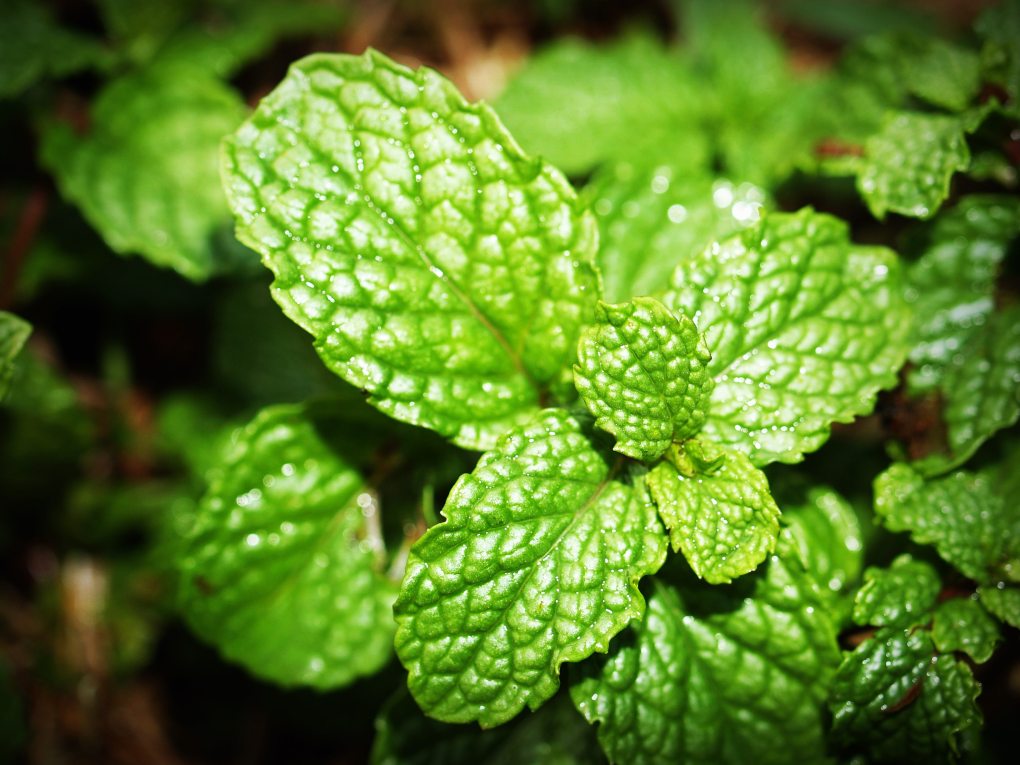
While we all know and love peppermint for its instant aroma of winter cheer, what you maybe didn’t know is that peppermint is a hybrid of spearmint and water-mint…that makes it like the golden-doodle of plants, right? Containing organic, Fair Trade peppermint essential oil from India and spearmint essential oil from Indonesia, both the Juniper Mint Castile Soap and the Matcha Mint Soap provide a big scrubba-dub-dub of rejuvenation. Did I mention that the Matcha Mint Bar also includes a refreshing measurement of matcha magic?…a matcha made in heaven!
How mint works to benefit skin
The rejuvenating quality of mint comes from the compound menthol. According to U.S National Library of Medicine, menthol triggers a specific receptor in our skin and the reaction is a cool-sensation. This creates a soothing feeling, which is especially great if you’re looking for the perfect exfoliation!
Toothpaste may be boring, but AVNS makes mint fun. You can choose from an amazing selection of minty combinations (including Rosemary Mint and Grapefruit Mint) and if you use a body or shampoo bar containing peppermint –like the Peppermint Tea Tree Shampoo Bar — who knows? You might even repel spiders! Only one way to find out!
As the newest member of Apple Valley Natural Soap, I’ll be writing informative and (hopefully) entertaining blogs inspired by AVNS’s products and the ingredients that go into making them. I could not be more thrilled about joining this fantastic, curl-friendly company!
I’ve been ruminating on a proper introduction and while I could go on for hours about my adorable dog, my passion for improv, and my international expeditions…I thought I’d share the aspect of my life that drew me to AVNS in the first place: my hair. However, in order to share my hair care journey, I’m going to have to come clean about something…
I Thought My Hair was Just Frizzy
I’m going to be honest,
I haven’t always taken care of my hair.
My hair was stick straight until sixth grade. Then it got frizzy. From seventh to tenth grade I blow-dried, straightened, and curled my hair with heat every day before school.
That’s right. For four years I woke up at five-thirty am every single morning so I could devote an extra hour to frying my hair.
Sometimes I’d have to straighten my hair and use a curling iron to keep my hair from frizzing up again.
I did the math.
There are about 165 school days in a year, so one hour per day is 165 hours a year. Multiply that by four and your total is 660 hours. Divide that by 24 hours and that’s 27.5 days. That’s almost an entire non-leap-year February.
A month. A month-long, hair-frying marathon.
I find this horrifying, but not surprising. You see, I didn’t know any better and there was no one to tell me otherwise. I was stuck with a head full of poodle frizz and every hair commercial I saw just enforced my belief that you were either born with beautiful hair or could fix it with heat if you weren’t. Because of this, I did not feel comfortable or confident with my own hair.
Straightening My Hair Hurt My Self-Esteem
Now, I want to make it clear that there is a difference between doing something because you want to and doing something because you think you have to. There is also a difference between touching up your hair a bit every once in a while and changing it every day because you are ashamed of leaving the house otherwise.
How your hair looks my not seem like a big deal, but when you feel forced to alter something about your appearance in order to conform to society’s standards you risk sending another, more damaging message to yourself that says, “the way you are is unacceptable.”
I’m going to tell you something right now: that message is a huge, unacceptable lie.
Thankfully, nature gave me a huge dose of reality…or should I say, douse?
How I found out my hair was curly
In eleventh grade my family went on vacation in Mexico and because of the weight limits on luggage I was also forced to take a vacation from my blow-dryer and curler. After a day spent playing in the ocean all that salt gave my hair the boost it needed to prove to me that it could do more than frizz.
I guess nature has a habit of bringing out the best in us.
At first I thought maybe the curly hair thing was a fluke. For a few weeks I dipped my hair in a bowl filled with table salt and water to get the same results as I had from the ocean (Yes, I looked ridiculous doing this) but eventually I did some research. I bought curly hair products, styled my hair when it was wet, and left the heat tools in my drawer.
I included this goofy picture of me circa 2017 so you could see what damaged curly hair looks like. See how the top of my hair is curly and the bottom looks kind of straw-like? It took two years of hair cuts and no heat to fix the damage I’d caused to my hair.
My Hair’s Journey from Straight to Curly
My hair’s transformation did not occur overnight: the years of straightening had damaged my natural curl pattern beyond repair. Weaning myself off of heat tools also took several years because I was so used to relying on them, but it was worth it.
My decision to embrace my natural hair means I get to feel ten times better about myself without making any adjustments.
How My Curly Hair Led Me to Apple Valley Natural Soap
AVNS wants you to look great, but more importantly we want you to go through life feeling great.
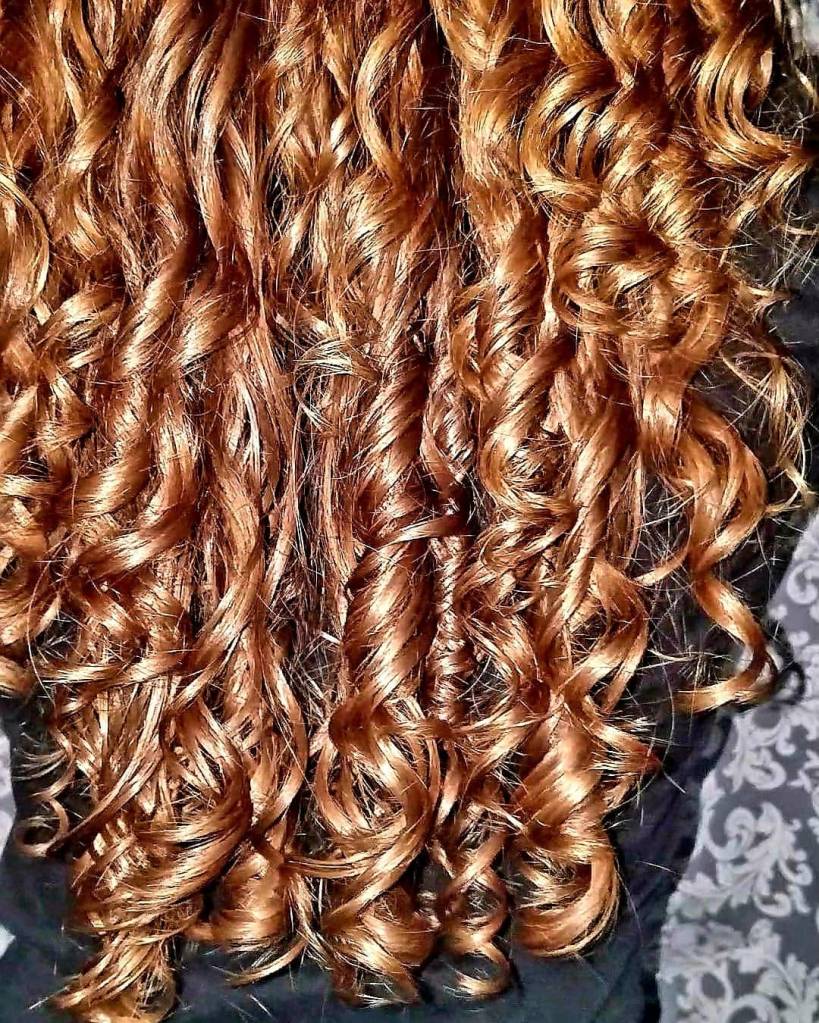
This is how my natural hair looks when I style it without heat. No curlers, just the perfect hair routine.
As a curly girl with defiant curls, I care about what goes into my hair products. Cheap brands of shampoo and conditioner may advertise products for curly hair, but if you take the time to pull out your magnifying glass and scan the ingredient list hidden on the back of your shampoo bottle, it will reveal silicones and sulfates (agents notorious for parching and dulling curls over time). Honesty in the health and beauty industry is so important, we want safe products with long term benefits and as consumers we want to invest in a company we can trust without constantly having to run DIY background checks on what we are using in our hair and on our bodies.
AVNS proudly displays our ingredient list right under every product description, and why wouldn’t we? From straight to spiral and everything in between, we’ve got shampoo bars that will nourish your silky strands. And that, my friend, is the honest truth.
Psst. Starting out on your curl journey and looking for something to help tame that frizz? Try the Lavender Silk or Jojoba Silk bar!
An acidic hair rinse is a critical part of your natural shampoo bar regimen. The acid in the rinse removes scaly build up and residue on the scalp and hair shaft, and smooths the cuticles/scales causing them to lie flat and SHINE. The acid also restores the natural pH of your scalp, preventing it from becoming dried out and itchy.
Each strand of hair has a cuticle which is made up of layers of protein, called keratin, scales cover the cuticle by overlapping each other. Healthy hair has scales that lie flat. Some commercial shampoos not only strip hair of its natural oils, but also injure the cuticle by tearing up the overlapping scales. Natural shampoo bars will not strip the hair of its natural oils, nor damage the cuticle and scales. You can read more about the benefits of our natural shampoo bars HERE.
Whenever hair becomes wet, the scales raise or soften slightly. Damaged hair also has raised scales, or “roughed up” cuticles. When washing hair with hard water, a high mineral content made up of mostly calcium and magnesium combine with the soap and form deposits on your hair (under and around the scales) weighing it down. Your hair may feel sticky and dirty no matter how often you wash it. Shampooing with soft water (which has a low concentration of minerals mostly of sodium and/or potassium ions), and following with an acidic rinse, will gently cleanse hair, remove deposits, and cause these scales to once again lie flat. This allows all residue to wash gently away leaving healthy shiny hair.
The Transition Phase. Most everyone when trying natural shampoo bars for the first time will experience this in one way or another. This transition phase can last anywhere from 1 day to 1 month. You can read more about it HERE.
Acidic Rinses.
Our Herbal Vinegar Hair Rinse is made with RAW certified organic apple cider vinegar. The vinegar is infused with nine certified organic herbs that your hair and scalp will love. Packed with trace minerals and vitamins, these herbs will nourish your scalp and strengthen your hair shaft. As we already mentioned, the acid in the vinegar removes scaly build up and residue on the scalp and hair shaft, and closes the cuticles causing them to lie flat and SHINE.
Organic ingredients and their benefits:
Because of its antiseptic properties, apple cider vinegar may help soothe the itching or irritation from psoriasis and other skin conditions. The acidity of vinegar works to remove build up from hair, it also balances the pH of scalp and hair, smoothes the cuticles and leaves hair feeling soft and silky.
Marshmallow Root softens hair naturally and promotes hair growth. It provides natural shine and soothes dry, itchy scalp.
Horsetail can improve circulation, leading to the improvement of hair follicles and scalp, which helps stimulate hair growth. It is also great for treating oily scalps and soothing skin ailments such as dandruff, eczema and psoriasis. The herb also rejuvenates hair, adding sheen and strength.
Nettles have been known to inhibit the hormone DHT helping to combat hair loss, and the astringent properties may help soothe conditions such as scalp eczema, dandruff and dry, itchy scalp. Nettles also have anti-inflammatory properties.
Chamomile is wonderful for conditioning the hair as well as soothing an itchy, irritated or sensitive scalp and preventing dandruff because of its antiseptic elements.
Lavender is wonderfully healing and soothing, it also reduces inflammation, promotes hair growth and is antimicrobial, meaning it’ll help prevent scalp issues such as itchy scalp, dandruff and infractions.
Comfrey Root restores sheen and volume to hair. It is also great for the scalp because of its healing properties which come from the many antioxidants, vitamins and minerals. The roots and leaves of comfrey also contain allantoin and tannin that promotes new cell generation.
Rosemary helps to stimulate follicles making the hair grow longer and stronger. It is also traditionally known to slow the appearance of grey hairs, to help curly hair, and to slow down premature hair loss. It has anti-viral, anti-fungal, and anti-bacterial properties, so is used to treat dandruff.
Calendula has antiviral, anti tumor, anti-inflammatory and antibacterial effects. It’s impressive because of its ability to speed healing and lower inflammation. It also promotes growth of stronger hair by increasing collagen production and circulation in hair follicles.
Yarrow is anti-inflammatory, antiseptic, and astringent making it ideal for treating scalp conditions and promoting hair growth.
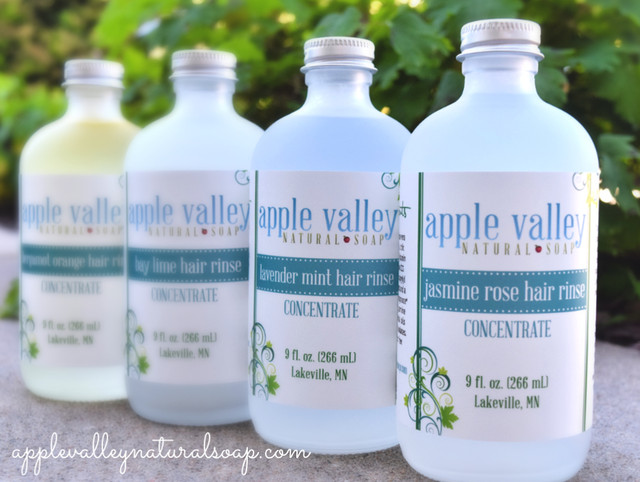
Our Citric Acid Rinses are a great alternative for those who do not like the smell of vinegar. Each of our sprays have the same the same pH value as apple cider vinegar but are rinsed out of hair after application. Unlike the Herbal Vinegar Rinse which has the option of being left in. As with the Herbal Hair Rinse, these rinses will help the cuticle scales to lie flat which helps remove build up and restore the natural pH, leaving hair soft and healthy.
Ingredients and their benefits:
Aloe vera contains something called proteolytic enzymes which repairs dead skin cells on the scalp. It also acts as a great conditioner and leaves your hair all smooth and shiny. It promotes hair growth, prevents itching on the scalp, reduces dandruff and conditions your hair.,
Essential oils: We’ve chosen a variety of essential oils for our rinses which not only smell divine, but also have wonderful healing properties. Bay essential oil is known for promoting wound healing and inhibiting growth of bacteria. Lavender, which has amazing healing and soothing properties. Rosemary which is used to prevent premature graying and dandruff. Tea Tree whose anti-fungal and antimicrobial properties make it effective for treating dandruff and seborrheic dermatitis. Frankincense is also excellent at promoting a healthy scalp and moisturizing existing hair follicles to prevent and treat hair loss and so on.
Citric Acid is a great help in treating and soothing itchy scalp, which often leads to hair loss and stops hair growth.
Ascorbic Acid, also known as vitamin C is full of antioxidants which help reduce free radicals. Free radicals can damage your hair making it brittle and more prone to split ends. Antioxidants also protect your hair helping it be stronger and grow quicker.
PlantaSol CCG (INCI Name: Caprylyl Capryl Glucoside) is Ecocert approved and is a vegetable-derived solubilizer. A solubilizer is used to help the essential oils blend well through out the rinse, but we chose this one because it is only rated as a 1 on the Skin Deep database.
As you can see, using an acidic hair rinse is a critical part of your natural shampoo bar regimen and will benefit both hair and scalp. Restore health and beauty to your hair by using natural shampoo bars and acidic hair rinses, your hair will shine with thanks!












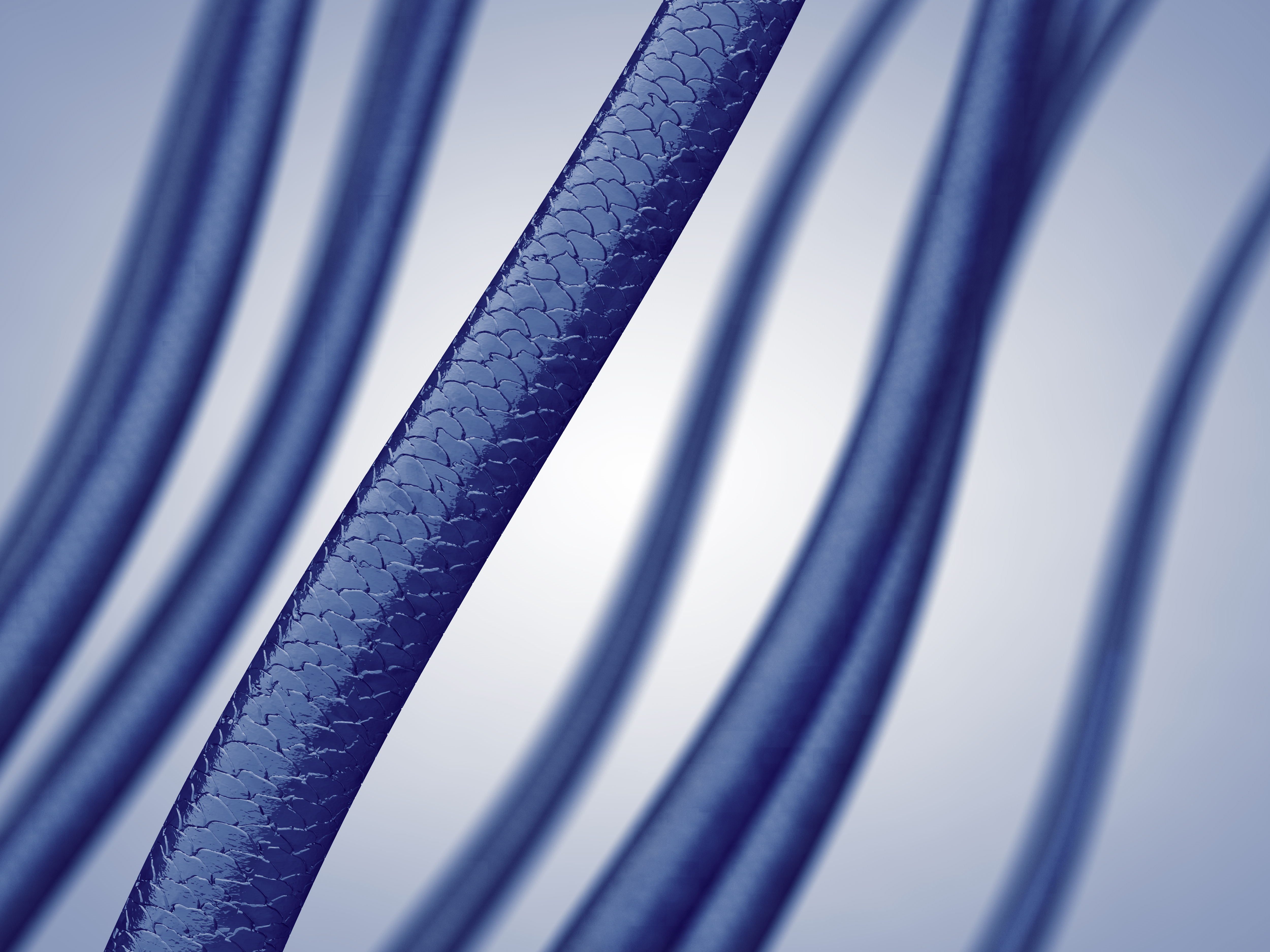 Each strand of hair has a cuticle which is made up of layers of protein, called keratin, scales cover the cuticle by overlapping each other. Healthy hair has scales that lie flat. Some commercial shampoos not only strip hair of its natural oils, but also injure the cuticle by tearing up the overlapping scales. Natural shampoo bars will not strip the hair of its natural oils, nor damage the cuticle and scales. You can read more about the benefits of our natural shampoo bars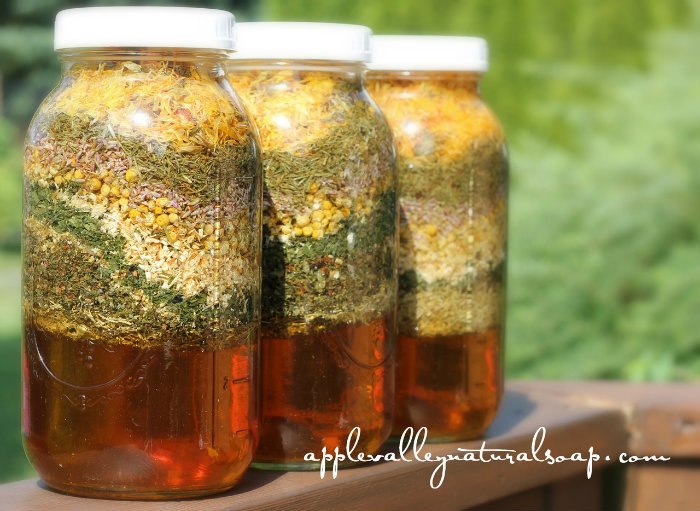
 APPLE VALLEY NATURAL SOAP BLOG